
BelleVue Country Club Presents
Tentôrium Tent
TENTORIUM is a portable smart tent; giant, substantial, tremendous ; dismountable, easy to move, installed and dismantled in record time, environmental friendly, safe, fire proof, non flammable and resistant to adverse weather
conditions.
(Concept Introduction)
BCC presents an innovative and groundbreaking concept in the field of portable smart tent design,
marketed under the brand name TENTORIUM.
TENTORIUM is a portable smart tent of monumental scale; giant, substantial, and tremendous in size
and capacity. It is fully dis-mountable, easy to transport, and can be installed and dismantled in
record time. The structure is environmentally friendly, highly safe, fireproof, non-flammable, and
resistant to adverse and extreme weather conditions.
TENTORIUM is designed to be fully independent and self-sufficient. It is equipped with modular
cubicles accommodating a comprehensive range of facilities and services, including pantries, coffee
shops, power generator systems, HVAC systems, videography and broadcasting facilities,
surveillance and security systems, ticketing windows, first aid clinics, fully self-contained lavatories,
storage units, and a dedicated lightning absorption chamber.
TENTORIUM regular series comprises three standard types forming a polygonal cone-shaped
structure: small, medium, and large. These variants have diameters of 75 / 112 / 150 meters,
covering areas of 5,000 / 10,000 / 20,000 square meters respectively. The frontage heights are
7 / 10 / 13 meters, while the internal roof heights reach 25 / 40 / 55 meters. The corresponding
weights are approximately 1,250 / 2,500 / 5,000 metric tons, and each configuration is capable of
accommodating 2,000 / 4,000 / 8,000 individuals respectively.
TENTORIUM will be submitted to the Guinness World Records to be recognized as the largest
portable tent in the world. The concept has been registered under intellectual property rights in
Lebanon and is in the process of applying for a patent with the World Intellectual Property
Organization (WIPO).
The slogan of TENTORIUM is “Safety First.” The structure has undergone the necessary structural
analysis and engineering design. (Which should be verified and approved by Bureau Veritas and
SOCOTEC, and to obtain certification from the International Organization for Standardization (ISO)
and will be insured by well-known international insurance firms, depending on the specific
geographical location.)
The TENTORIUM tent is envisioned as an architectural edifice akin to a ship recovered from the
oceans and seas, transported to the foothills of the Akkar Mountains in Lebanon, then transiting
through the mirages of the deserts of the Kingdom of Saudi Arabia and the Gulf, to finally be
moored in the public squares of capitals and cities worldwide.
As for the intended objective and the greatest dream of the innovator (Mohamad A. Daher), it is to
transform this metaphorical “ship” tent into a tangible reality and to restore this edifice to the place
from which it was metaphorically recovered.
1/2(Design, Specification & Methodology)
The structural design concept of TENTORIUM is based on trigonometric principles, specifically the
30° / 60° / 90° triangle, and adopts, as much as possible, the Fibonacci sequence and the golden
ratio (phi ɸ).
The applied technology consists of a dual tightening cabling system, shipping standard container
units, bespoke structural components, container corners and accessories, marine-grade lashing
equipment, and various maritime turnbuckles and shackles. All these elements have obtained
international design approval, quality pre-approval, and certification.
The TENTORIUM design specification features a peripheral enclosure composed of a series of
shipping standard container units used as frontage, stacked in a polygonal configuration, either
longitudinally and/or transversely. These units are elevated by adjustable skids positioned on one of
the two sides of the polygon, with adjustable angled panels in between. These panels incorporate
light-penetration windows and pull-up openings equipped with emergency exit doors.
The container units also function as anchoring elements for tightening the pitched roof dual cabling
system. This system is stretched from a top notch positioned at the apex of the central column and is
secured to the ground by deep-row anchor bolts, further supported by multiple boulder
counterweight blocks.
The TENTORIUM textile roof is composed of a specially tailored PTFE fabric structure.
Polytetrafluoroethylene (PTFE) is a synthetic fluoropolymer of tetrafluoroethylene with numerous
applications and is commonly known under the trade name Teflon. It exhibits the following
characteristics:
• High resistance to weather conditions and immunity to ultraviolet radiation
• Very high tensile strength
• Fireproof and non-flammable properties
• High solar reflection capability
• Self-cleaning surface characteristics
The architectural methodology of TENTORIUM includes a colossal entrance porch supported by a
single vertical pestle, and a conical roof that is polygonal in plan on a flat plane, using shipping
container units as the peripheral frontage. The structure rises to a single apex, forming a cone shape
composed of one central column acting as a tripod system. This column incorporates a rotating
central podium and allows for maximum internal spacing with completely unobstructed 360-degree
visibility.
The upper section of the central column integrates a firefighting water tank system, followed by a
prefabricated cowl used as an air extraction system, and is topped by a telescopic pinnacle carrying
the logo flagpole, a warning flashing light, and a lightning rod.
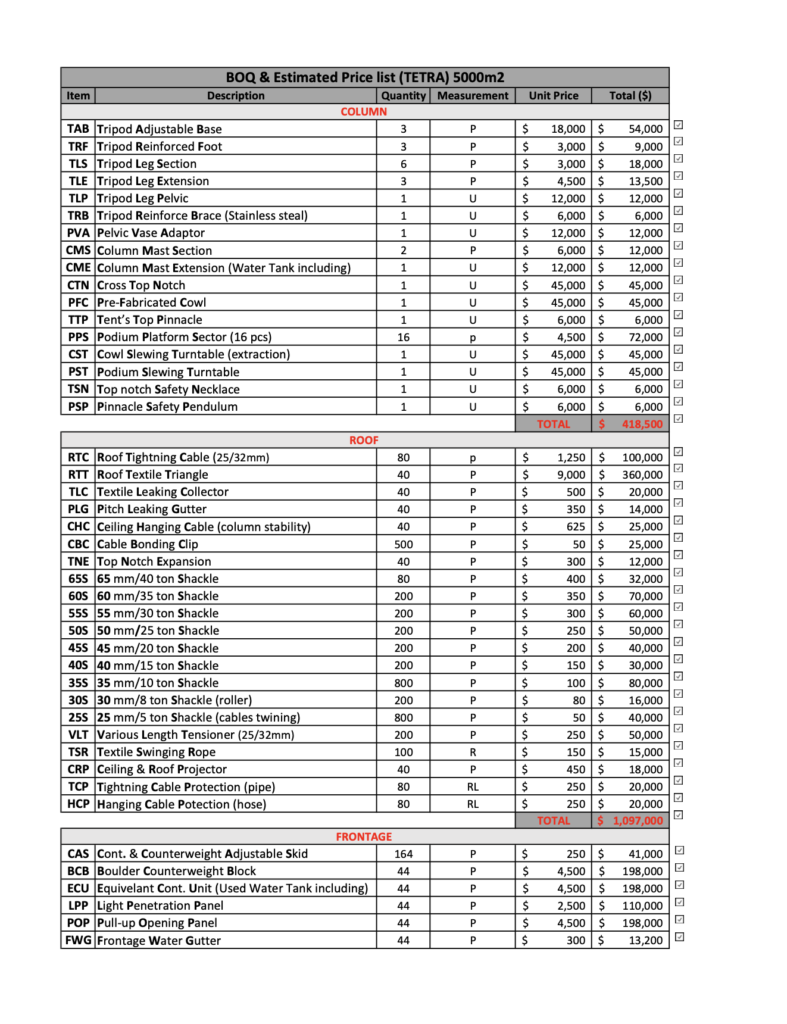
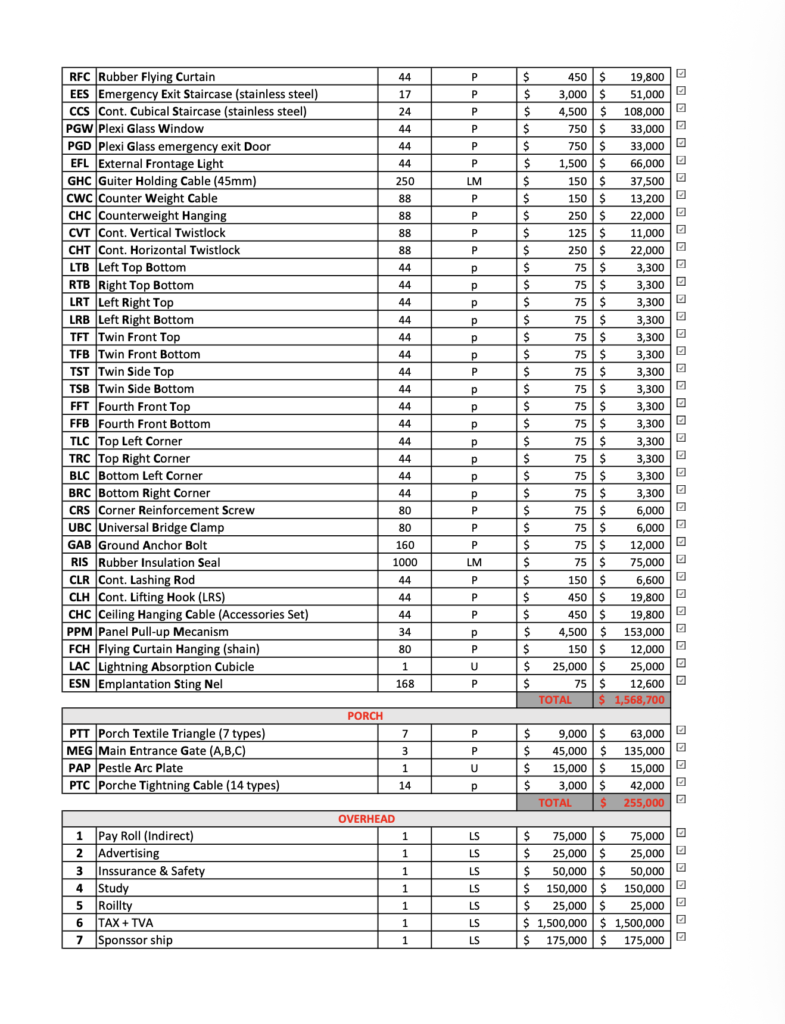

TENTORIUM – Engineering and Cost Philosophy – 1,700 USD per m²
Epoxy Marine Steel Mega-Structure – Fully Demountable, Self-Balanced Tent System
1. Project Definition
TENTORIUM is a giant, fully demountable, transportable tent (mega-structure) engineered for
high-capacity public use.
It is suitable for deployment in urban plazas, public parks, desert environments, coastal zones,
and o shore-adjacent installations.
Key Features:
• Operates as a self-balanced engineered system, eliminating the need for permanent civil
foundations.
• Combines marine-grade durability, modular architectural flexibility, and long-term
reusability.
2. Deployment Sizes and Structural Mass
• A 5,000 m² tent carries approximately 1,250 metric tons.
• A 10,000 m² tent carries approximately 2,500 metric tons.
• A 20,000 m² tent carries approximately 5,000 metric tons.
Note: Structural mass increases proportionally with span, wind exposure, live load, occupancy
capacity, and integrated systems.3. Counterweight Engineering System
• TENTORIUM tent is stabilized via a fully engineered counterweight system.
• Counterweights are calculated as part of the structural load model and fabricated in
advance within the beneficiary country using local concrete and steel.
• They are not transported internationally and do not require on-site casting.
This ensures logistical e iciency, structural precision, and economic rationality.
4. International Cost Benchmark
• Reference Price: ≈ 1,700 USD/m²
• Represents full structural, architectural, mechanical, and safety integration.
• Unit cost remains constant regardless of total area, because structural responsibility
increases with size:
• Steel sections increase with span
• Cable diameters increase
• Wind and live loads increase
• Safety and utility systems expand
• No economy-of-scale reduction applies; engineering obligation grows with scale.
5. Scope Included Within 1,700 USD/m²
Structural Systems:
• Epoxy marine-painted steel (central mast & tripod)
• High-tensile certified cable systems
• PTFE tensile membrane roofing
• Certified marine anchoring and tension assembliesModular Tent Architecture (Containers):
• 20-ft marine-grade containers
• Kitchens, toilets, sanitary facilities
• Security rooms, ticketing rooms, administrative o ices
• Stainless steel staircases
• Mechanized controlled-access openings
• Advertising platforms, integrated lighting
• Container spacing: 6 meters
• Upper-level windows allow daylight penetration
• Ground-level openings contain mechanized emergency exits, resembling traditional
Bedouin spring tents
Utilities & Infrastructure:
• Air-conditioning units
• Power generation systems
• Electrical distribution
• Firefighting water tanks
• Kitchen & sanitary water tanks
• Fully integrated MEP systems
All elements are structurally accounted for within the square meter benchmark.
6. Architectural Configuration & Mechanized Opening
• Ground-level openings operate mechanically, independently or synchronously.
• When elevated, they provide:
• Clear evacuation paths• Enhanced cross ventilation
• Expanded shaded zones
• Visual appearance inspired by semi-open spring tents
• Tent can operate in semi-open mode without mechanical cooling in moderate climates
while maintaining structural integrity.
7. Safety & Compliance
• Fire-rated, non-flammable materials
• Certified anchoring and tension systems
• Lightning protection and grounding
• Engineered crowd evacuation planning
• Structural verification studies
• Third-party certifications
• Insurance compliance according to local regulations
All safety systems are embedded within the structural design.
8. Pricing Adaptation – Lebanon Execution
• International benchmark: 1,700 USD/m²
• Price may vary depending on local regulations, insurance, import procedures, and
logistical complexity.
• Execution in Lebanon is typically ≈25% lower due to:
• Lower labor costs
• Reduced regulatory burden
• Use of recycled or refurbished materials without compromising safety or structural
integrity
• Material/equipment customization can be discussed without a ecting structural
performance or public safety.9. Structural Concept Summary
• TENTORIUM tent functions as a self-balanced structural system, similar in principle to
o shore platforms.
• Fully deployable in deserts, public squares, parks, and metropolitan areas without
permanent foundations.
• Structurally autonomous, operationally self-su icient, environmentally adaptable.
10. Manufacturing, Installation, and Dismantling Schedule
Manufacturing (from contract signature):
• 5,000 m² → 3 months
• 10,000 m² → 6 months
• 20,000 m² → 9 months
Installation or Dismantling (upon request):
• 5,000 m² → 1 month
• 10,000 m² → 2 months
• 20,000 m² → 3 months
Note:
– Durations scale proportionally with structural mass and system integration.
– The quoted price is preliminary
Mega-Tent vs. Iconic Dome – Inflation-Adjusted Cost Comparison
TENTORIUM – Mobile Mega-Tent
TENTORIUM is a fully portable, self-balanced mega-tent designed for multiple deployments.
Heights range 15-40-55 meters, and typical areas span 5,000 to 20,000 square meters. The cost per
square meter is 1,700 USD, adjusted for current market conditions. Its key advantage is mobility
and reusability, allowing operation in urban plazas, parks, deserts, and coastal zones without
permanent foundations, making it extremely cost-e ective for large-scale temporary or semi-
permanent applications.
Khan Shatyr – Astana, Kazakhstan
Opened in 2010, Khan Shatyr is a permanent tensile mega-tent covering over 100,000 square
meters with a central mast reaching 150 meters. Original cost was ~4,000 USD per square meter.
Adjusted for 14 years of average construction inflation (~4.5% annually), the current cost per
square meter is roughly 7,300 USD. It is designed for long-term public use with integrated retail,
entertainment, and recreational facilities.
Jeddah Super Dome – Saudi Arabia
The Jeddah Super Dome is a permanent high-end dome covering 34,000 square meters. Original
construction cost was about 1.2 billion SAR (≈320 million USD), giving an initial cost of ~9,400 USD
per square meter. Adjusted for eight years of Saudi construction inflation, including post-COVID
impacts, the current cost per square meter is roughly 12,000 USD. The dome is permanent, with
fully integrated utilities, safety systems, and architectural complexity.
Comparison Summary (Per Square Meter)
• TENTORIUM: 1,700 USD/m² – Mobile, reusable, highly cost-e icient.
• Khan Shatyr: ~7,300 USD/m² – Permanent tensile mega-tent, iconic design.
• Jeddah Super Dome: ~12,000 USD/m² – Permanent high-end dome, full facilities.
Key Observation
TENTORIUM remains significantly more affordable per square meter compared to the largest
permanent mega-structures in the world. Its mobility, reusability, and modularity provide
unmatched cost e iciency while maintaining structural integrity and large-scale capacity. Even
after adjusting for inflation, the difference is substantial: TENTORIUM is over 4 times cheaper than
Khan Shatyr and over 7 times cheaper than the Jeddah Super Dome.
مقارنة أسعار بالوزن !
Jeddah Super Dome: الوزن ≈ 1,600,000 كغم، السعر ≈ 320 مليون دولار،
سعر الكيلو ≈ 200 $/كغم.
Khan Shatyr (أكبر خيمة بالعالم): الوزن ≈ 2,300,000 كغم، السعر ≈ 350 مليون دولار،
سعر الكيلو ≈ 152 $/كغم.
Boeing 747‑400 قديمة عاملة: الوزن بدون وقود ≈ 160,000 كغم، السعر ≈ 22.5 مليون دولار،
سعر الكيلو ≈ 141 $/كغم.
باخرة ركاب صغيرة: الوزن ≈ 25,000,000 كغم، السعر ≈ 180 مليون دولار،
سعر الكيلو ≈ 7.2 $/كغم.
TENTorium (المقصودة): الوزن ≈ 1,250,000 كغم، السعر ≈ 8.5 مليون دولار، سعر الكيلو ≈ 6.8 $/كغم ✅
مبنى خمسة طوابق (1,000 م² لكل طابق): الوزن ≈ 2,500,000 كغم، السعر ≈ 10 مليون دولار،
سعر الكيلو ≈ 4 $/كغم